Biblioteca Ambrosiana · c. 1480–1482
Manuscript · Source record ↗
01 / 14 · Water + motion
Water-raising machines
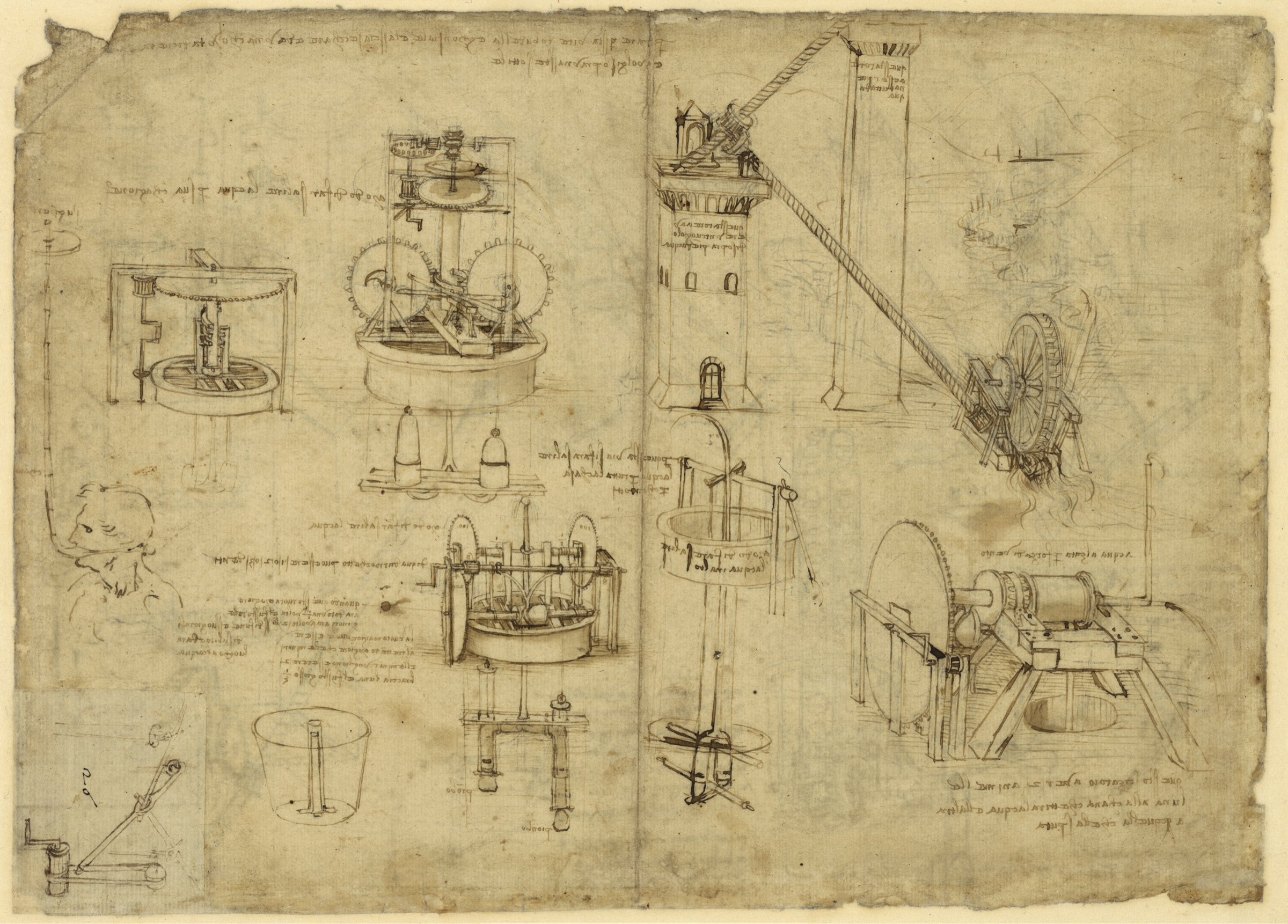
Codex Atlanticus, folio 1069r. Pen, ink and wash studies of water-raising mechanisms, screw forms and a siphon bucket. This sheet records several mechanisms rather than one finished machine. [Source]
A mechanism drawing can become a power budget before its gears become detailed geometry.
The contemporary study
How much shaft power lifts a chosen water flow?
Flow, lift height, efficiency → shaft power → drive check.
Scope boundary. A steady hydraulic power budget; no gear motion, cavitation or pump curve. Efficiency is assumed.
Historical idea → contemporary chat workflow
Five exchanges to make it testable.
The prompts below reinterpret the engineering question. They are not reconstructed historical conversations.
- 01
Preserve the source and the question
Create a Napkin study called “Water-raising machines — illustrative sizing”. Keep the attached historical drawing as a source reference. Preserve pump topology and the water-lift intention; never infer dimensions from the folio. The engineering question is: How much shaft power lifts a chosen water flow? Do not invent historical dimensions or ratings.
napkin_capabilities → napkin_create → napkin_snapshot; optional napkin_edit set-drawing for source metadata.
- 02
Separate facts from assumptions
List what the source supports, what is uncertain, and what must be measured. For this first pass use clearly labeled modern illustrative values, never historical measurements. Model this chain: Flow, lift height, efficiency → shaft power → drive check.
Input quantities carry units, ranges, tolerances and assumption strings. Derived quantities retain equations.
- 03
Encode the compact sketch model
Use napkin_sketch to apply the following text to the study with the current expectedRevision and prefix "davinci". Explain pumpPower and open the study. These numbers are illustrative assumptions.
napkin_snapshot → napkin_sketch → napkin_explain → napkin_open; scalar code below.
- 04
Ask a decision question
Does required power exceed 200 W at 5 L/s? Which input dominates? Run the named scalar sweep in analytic mode and use napkin_analyze sensitivity for pumpPower versus flow. Report units, the check outcomes and assumptions; keep baseline inputs unchanged.
napkin_run for the sweep; napkin_analyze kind=sensitivity using returned quantity refs.
- 05
Compare against evidence and revise
Measure flow, lift and input torque/speed on a bench pump; compare power and losses. Attach test or external-analysis evidence as source references. Compare like-for-like conditions, explain any discrepancy, and revise only inputs justified by that evidence. Report what the model still cannot answer.
napkin_explain → evidence reference via napkin_edit → revision-checked input update → rerun; prior runs become stale.
Step 03 · paste alongside the prompt
A runnable sketch model
Every number is a modern illustrative assumption, not a historical reconstruction.
= defines inputs; := defines derived quantities; check states the decision threshold; sweep changes one input across scalar cases.
Verified with the repository’s parser and analytic evaluator.
Baseline checks: passed · three-case sweep checks: failed.
A failed check is a design result, not a syntax failure.
rho = 1000 kg/m^3 "Illustrative water density"
g = 9.81 m/s^2
flow = 0.002 m^3/s in 0.001..0.005 ± 10% "Modern illustrative flow"
head = 3 m "Assumed lift height"
efficiency = 0.45 "Assumed overall efficiency"
pumpPower := rho*g*flow*head/efficiency [W]
check drive: pumpPower <= 200 W
sweep Flow: flow = 0.001, 0.002, 0.005 m^3/s